Anthony Ofori | Medical Graduate in General Medicine | Founder, WellNest Central
Last updated: October 12, 2026
This article provides general health education for adults and does not replace individual medical advice.
You measure your blood pressure on the left arm, switch to the right, and get a different number. Which reading should go into your log? Is one arm more accurate, or is the difference itself a warning?
Different blood pressure readings in each arm can reflect ordinary variation, the timing of measurements, or technique. A persistent difference deserves clinical review. Once the higher-reading arm has been identified reliably, it is generally the arm used for ongoing measurements, unless your healthcare team gives you different instructions.
The key is to confirm a pattern rather than choose whichever number feels more reassuring.
Why can the two arms give different readings?
Blood pressure changes from moment to moment. When you measure one arm and then the other, you are comparing different locations at different times. You may also become more relaxed during the second measurement.
Position, cuff fit, muscle tension, and movement can contribute. If one arm is supported at heart level and the other hangs down, the comparison is not being made under equivalent conditions.
Sometimes a reproducible difference reflects a difference in blood flow through the arteries supplying the arms. You cannot diagnose that from two home readings, but a clinician can decide whether it needs investigation.
WellNest Central support
Build practical habits for better health
Explore educational support for nutrition, movement, sleep, and everyday health routines.
Which arm should you use for routine checks?
Ask your clinician to compare both arms during an initial assessment. If one arm consistently reads higher, using that arm helps avoid underestimating your blood pressure.
NICE’s adult hypertension guideline recommends repeating measurements when the difference between arms is more than 15 mm Hg. If that difference persists on the repeat measurement, subsequent readings should be taken in the higher-reading arm.
This is a measurement recommendation, not a diagnosis of an artery problem. A single difference does not establish disease, and the threshold is not a reason to ignore other concerning findings.
If you have been told to avoid measurements on one arm—for example, because of a dialysis access or another individual medical reason—follow that instruction and ask your team how to monitor safely.
Make the comparison fair
The NHLBI’s blood-pressure diagnosis guidance explains the importance of preparation and positioning. Before a planned measurement, avoid exercise, caffeine, and smoking for at least 30 minutes, empty your bladder, and rest quietly for five minutes.
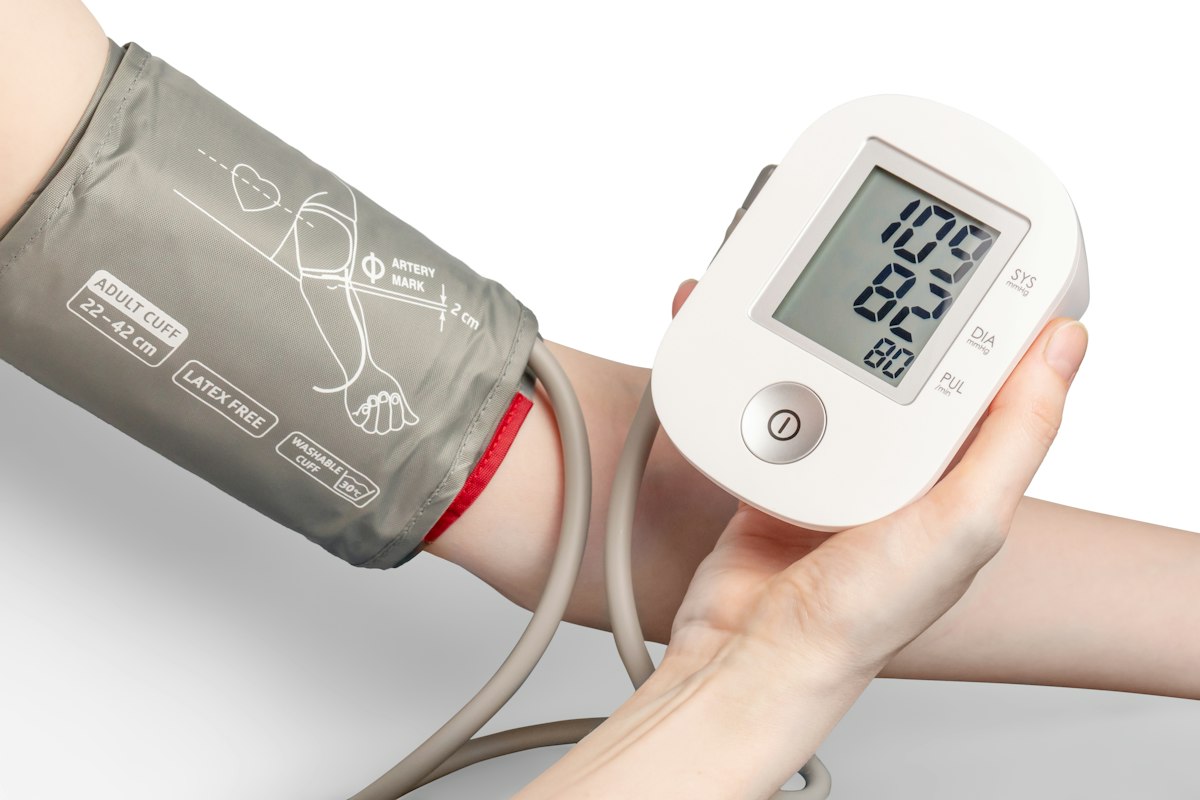
Sit with your back supported, feet flat on the floor, and legs uncrossed. Use a validated upper-arm monitor with a cuff suitable for the arm being measured. Support the arm so the cuff is at heart level.
Place the cuff on bare skin and follow the manufacturer’s positioning instructions. Avoid talking, scrolling on your phone, or holding your arm up using your own muscle strength while the device works.
These details matter on both sides. Our guide to checking whether your blood pressure cuff is too small explains why fastening the cuff does not necessarily mean it fits correctly.
What should you write down?
Record the top and bottom numbers, the arm used, the time, and any relevant circumstance. For example: “Right arm, seated after rest, before breakfast.” Keep both readings when comparing arms.
Do not silently switch arms halfway through a monitoring period. If you have been advised to change to the higher-reading arm, note the date so your clinician understands why the pattern may look different.
Here is an illustrative example: a left-arm reading of 126/78 and a right-arm reading of 143/82 should not be reduced to “my blood pressure is 126/78.” Both results and the conditions in which they were taken need review.
That example does not diagnose hypertension. It shows why discarding the higher number can remove useful information from your record.
Should you average the two arms?
Do not average a lower arm and a higher arm simply to obtain a middle value. That can conceal a meaningful difference.
A clinician may ask you to average repeated readings collected from the selected monitoring arm over several days. That is different from combining two arms that may have different usual pressures.
Follow the monitoring schedule you were given. Repeatedly moving the cuff back and forth for an hour can make the process stressful without producing a clearer answer.
If your first reading commonly exceeds the next one, our article on why the first blood pressure reading can be higher discusses how settling and repeated measurement affect the pattern.
When should you ask for medical review?
Arrange a review if one arm repeatedly reads higher, especially when the systolic difference is around 15 mm Hg or more. Bring your monitor and log so the clinic can check your equipment, technique, and both arms.
You should also discuss consistently elevated readings even if the arms agree. Having matching numbers does not make high blood pressure harmless.
Your clinician may confirm the difference, review cardiovascular risk, examine pulses, or consider further testing depending on the findings. Not everyone with an inter-arm difference needs a scan.
Do not change medication doses yourself or use the lower-reading arm as a reason to skip treatment. The care plan should be based on reliable measurements and your overall health.
When to seek urgent help
The American Heart Association’s home-monitoring guidance advises urgent action for very high readings. If systolic pressure is above 180 or diastolic pressure above 120 and you have no concerning symptoms, wait at least one minute and repeat. If it remains that high, contact your healthcare professional immediately.
Call emergency services for a very high reading with chest pain, breathlessness, weakness, vision changes, or trouble speaking. Sudden severe chest or back pain, fainting, or a newly painful, cold arm also needs urgent assessment regardless of what the monitor shows.
Do not delay care while repeatedly comparing arms. Use 911 in the United States or 112 in the European Union for an emergency.
A useful plan for your next appointment
Ask: “Have we checked both arms?” “Which arm should I use at home?” and “What reading or symptom should make me call sooner?” Write the answers beside your monitoring log.
Consistent technique and a clearly chosen arm make future readings easier to interpret. The purpose is to capture your blood pressure accurately enough to guide good decisions, rather than search for the lowest possible number.
Want support with your everyday health habits?
Explore educational lifestyle support alongside the care you receive from your healthcare team.
Explore One-on-One Consultation Options