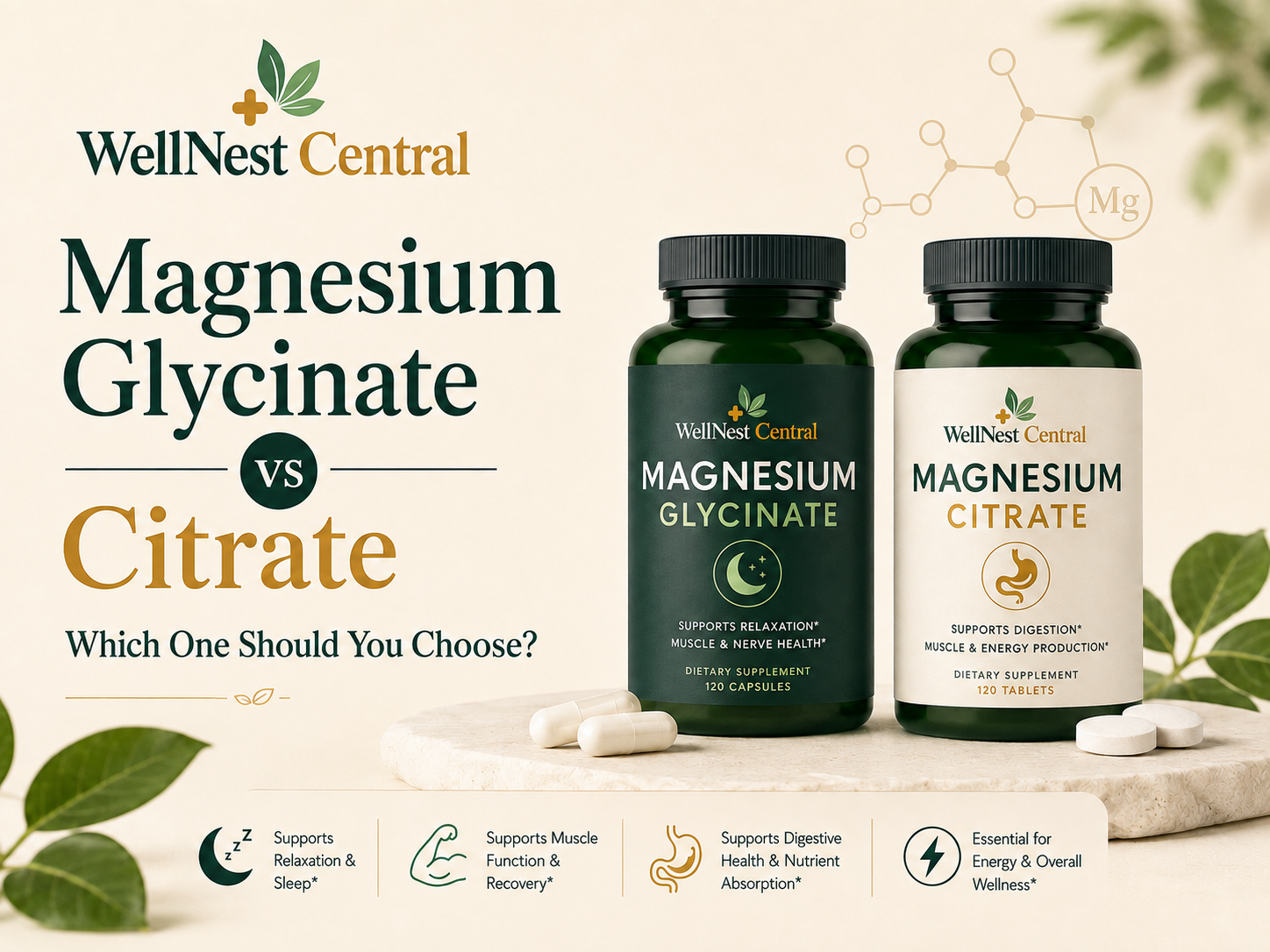
Magnesium is one of those nutrients that appears in many conversations about nutrition, energy, muscles, relaxation and general wellbeing.
And once you decide that you would like to include magnesium in your routine, another question quickly appears:
Which form should I choose?
Two of the most popular options are magnesium glycinate—also commonly called magnesium bisglycinate—and magnesium citrate.
Both can be useful choices. The better option depends less on finding one universal “winner” and more on understanding what each form offers and how well it fits your own routine.
Magnesium itself plays a role in hundreds of biochemical reactions in the body, including processes involved in muscle and nerve function, energy production, protein synthesis, blood glucose regulation and bone health.
So when comparing magnesium glycinate vs magnesium citrate, the important question is not whether magnesium is valuable. It is how to choose the form that makes the most sense for you.
PERSONALISED SUPPLEMENT SUPPORT
Not sure which magnesium form fits your needs?
Diet, bowel habits, medication, kidney health and the amount of elemental magnesium all matter. A one-on-one consultation can help you compare the options and prepare sensible questions before choosing.
Explore magnesium options
You can visit The WellNest Supplement Guide to explore magnesium and other supplement categories, with shopping options organised for Germany/EU, the United Kingdom, US/Canada, Australia/New Zealand and other countries worldwide.
This article links to The WellNest Supplement Guide, which contains affiliate links. WellNest Central may earn a commission from qualifying purchases at no additional cost to you.
What is magnesium citrate?
Magnesium citrate is magnesium combined with citric acid.
It is one of the better-established supplemental forms of magnesium and has been studied specifically for its absorption.
The U.S. National Institutes of Health lists magnesium citrate among the magnesium forms that tend to be more easily absorbed than some less-soluble forms such as magnesium oxide.
Clinical research also supports this. In a randomized double-blind study comparing magnesium citrate, magnesium oxide and an amino-acid-chelated magnesium preparation, citrate produced greater measures of magnesium availability than magnesium oxide and performed strongly among the forms tested.
An earlier human study also found magnesium citrate to be considerably more soluble and bioavailable than magnesium oxide.
That gives citrate an advantage that I like when evaluating supplements: there is direct human evidence behind its absorption.
For someone who wants a straightforward, well-studied magnesium supplement, citrate can therefore be a very practical option.
What is magnesium glycinate?
Magnesium glycinate, or magnesium bisglycinate, is magnesium bound to the amino acid glycine.
This makes it an amino-acid-chelated form of magnesium rather than a mineral combined with an organic acid such as citrate.
Glycinate has become increasingly popular in wellness products, particularly among people who prefer an amino-acid-chelated magnesium supplement.
Research on magnesium bisglycinate is also developing. A 2025 randomized placebo-controlled trial involving adults who reported poor sleep found a modest improvement in insomnia severity after four weeks of magnesium bisglycinate supplementation compared with placebo. The effect was small, so the study should not be interpreted as proof that glycinate is a universal sleep supplement, but it adds useful clinical evidence to this form of magnesium.
Research directly comparing magnesium glycinate with citrate is still much more limited than the evidence available for citrate versus magnesium oxide. That means claims that glycinate is always “better absorbed” than citrate are stronger than the current evidence supports.
That does not make glycinate a poor choice.
It simply means that both forms can have a place, and citrate currently has more established direct evidence for absorption.
Magnesium glycinate vs magnesium citrate at a glance
| Feature | Magnesium Glycinate | Magnesium Citrate |
|---|---|---|
| Form | Magnesium bound to glycine | Magnesium bound to citric acid |
| Type | Amino-acid chelate | Organic magnesium salt |
| Absorption evidence | Growing evidence | Stronger established human absorption evidence |
| Good fit for | People who prefer a chelated magnesium form | People wanting a well-studied, readily absorbed form |
| Routine | Often chosen for simple daily supplementation | Easy to incorporate into a daily magnesium routine |
| What matters most | Elemental magnesium, formulation and personal fit | Elemental magnesium, formulation and personal fit |
The important message is that the name on the front of the bottle is only part of the decision.
Look at elemental magnesium, not just the compound name
This is one of the most useful things to understand when shopping for magnesium.
A bottle might say:
Magnesium Bisglycinate 1,000 mg
or:
Magnesium Citrate 1,500 mg
That does not necessarily mean you are receiving 1,000 or 1,500 mg of magnesium.
The amount that matters nutritionally is the elemental magnesium contained within that compound.
The NIH specifically notes that the Supplement Facts panel on U.S. magnesium products declares the amount of elemental magnesium rather than the total weight of the magnesium compound.
So when comparing two products, turn the bottle around and look for the actual magnesium amount per serving.
This often gives you a much more useful comparison than the large number printed on the front.
If you would like a broader framework for comparing supplement labels, formulations and quality, you can also read How to Choose Supplements Wisely: 7 Simple Checks for Better Results.
How much magnesium do adults need?
This is another area where it is useful to look at both American and European guidance.
In the American system, the NIH reports adult magnesium recommendations ranging from 310 to 420 mg per day, depending on age and sex. For example, the U.S. recommendation is 400–420 mg daily for most adult men and 310–320 mg for most adult women. These values refer to magnesium from the overall diet and other sources, not simply the amount that needs to come from a supplement.
EFSA established adequate intakes of 350 mg per day for adult men and 300 mg per day for adult women.
The numbers are not identical because nutrition authorities can use different methods when developing reference values.
The practical message is simpler:
Your magnesium supplement does not exist in isolation.
Magnesium can also come from foods such as nuts, seeds, legumes, whole grains and green leafy vegetables.
A supplement can then become a convenient way of complementing that dietary intake.
Which one should you choose?
If your priority is choosing a magnesium form with strong, direct evidence for absorption, magnesium citrate is an excellent place to start. NIH includes citrate among the more readily absorbed forms, and several human studies have supported its bioavailability.
If you specifically prefer an amino-acid-chelated form, magnesium glycinate or bisglycinate is also a reasonable choice. Research on this form continues to develop, including recent clinical research.
For many people, therefore, the decision may come down to the complete product rather than the word “citrate” or “glycinate” alone.
Look at the elemental magnesium amount, serving size, formulation, number of capsules required, manufacturer, price and how easily the product fits into your normal routine.
That is often more useful than trying to find one form that everyone should take.
What I would look for on the label
When I compare magnesium products, I focus on a few simple details: the form of magnesium, the amount of elemental magnesium per serving, the serving size, the other ingredients and whether the manufacturer presents the information clearly.
That follows the same principle we discussed in our broader supplement guide: choose with purpose rather than simply following the biggest claim on the bottle.
The NIH notes that magnesium absorption differs among formulations and that forms that dissolve more readily generally tend to be absorbed more completely.
That is one reason why the formulation matters.
At the same time, supplements work best when they fit comfortably into the bigger picture of food, lifestyle and individual nutritional needs.
EFSA similarly describes supplements as concentrated sources intended to complement the normal diet.
Do you need to choose only one?
Not necessarily because one form is inherently “good” and the other “bad.”
The goal is simply to find the product that suits your nutritional plan.
Some people may prefer citrate because of its established absorption evidence.
Others may prefer glycinate because they specifically want an amino-acid-chelated form.
And someone else may use a completely different magnesium formulation.
This is why I prefer purposeful supplementation rather than rigid rules.
You are choosing a nutrient delivery system that should work for your lifestyle.
The bottom line
When comparing magnesium glycinate vs magnesium citrate, both can be worthwhile magnesium options.
Magnesium citrate has the stronger established evidence for absorption and is explicitly listed by the NIH among the more readily absorbed supplemental forms.
Magnesium glycinate offers an amino-acid-chelated alternative, and emerging clinical research continues to explore its potential uses.
Rather than asking:
“Which magnesium is the best?”
I would ask:
“Which magnesium form, dose and formulation best fit what I want from my supplement routine?”
That question usually leads to a much more useful answer.
🌿 Choose your supplements with purpose
Explore The WellNest Supplement Guide to compare magnesium and other supplement categories and see available shopping options for Germany/EU, the United Kingdom, US/Canada, Australia/New Zealand and other countries worldwide.
CHOOSE SUPPLEMENTS WITH PURPOSE
Look beyond the name on the bottle
Book a private consultation to review your diet, lifestyle and supplement routine together, with practical guidance tailored to your goals and circumstances.
Anthony Ofori | Medical Graduate in General Medicine | Founder, WellNest Central
Last reviewed: 13 September 2026
This article is for general education and is not a substitute for medical advice, diagnosis or treatment. Speak with an appropriately licensed healthcare professional before using magnesium supplements if you have kidney disease, take regular medicines, are pregnant, or have persistent symptoms.



Pingback: Which Supplements Are Worth the Money? A Practical Value Guide