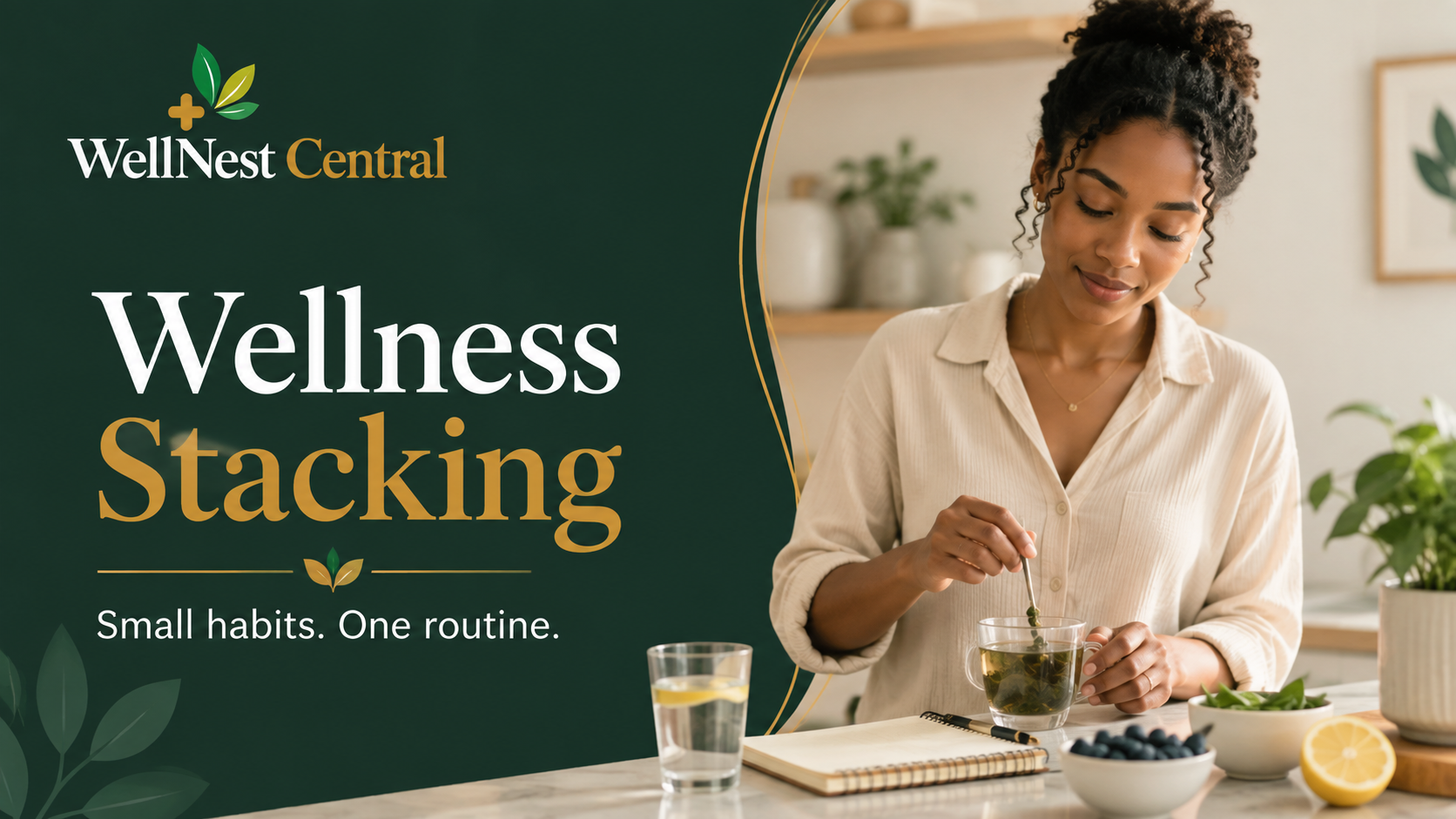
Most people already know many of the things that can support better health.
Drink enough water.
Move your body.
Eat nourishing meals.
Get enough sleep.
Manage stress.
Spend some time outside.
The problem is often not knowing what to do.
The problem is finding the time and consistency to actually do it.
That is one reason a trend called wellness stacking has been gaining attention.
The idea is simple: instead of treating every healthy habit as another separate task on your already busy schedule, you combine a few small habits with routines you already have.
For example:
Your morning coffee can become coffee + a glass of water.
Your daily walk can become walking + listening to something relaxing.
Breakfast can become breakfast + a good source of protein.
Watching television can become television + a few minutes of stretching.
The goal is not to fit twenty wellness activities into one morning.
The goal is to make healthy choices easier to remember, easier to repeat and easier to fit into real life.
Wellness stacking has recently gained attention on social media as an extension of the broader idea of habit stacking. Behaviour-change research supports the importance of repetition, stable routines and consistent contexts when developing health-related habits.
What Is Wellness Stacking?
Wellness stacking means combining small health-supporting behaviours into routines you already perform.
Instead of thinking:
“I need to find another 30 minutes to do something healthy.”
You begin asking:
“Where can I naturally add one small healthy action to something I already do?”
That difference matters.
Habits are strongly influenced by cues and repeated contexts. A large systematic review of health-related habit formation found that repetition, routine stability, implementation plans and the context in which an activity is performed can influence how strongly habits develop.
In simple terms:
When an action has a regular place in your day, remembering it can become easier.
That is the foundation of wellness stacking.
Why Wellness Stacking Can Feel Easier
Many people attempt lifestyle change by changing everything simultaneously.
Monday arrives and suddenly they plan to:
Wake at 5:30 a.m.
Exercise for an hour.
Drink three litres of water.
Stop eating sugar.
Prepare every meal.
Meditate.
Journal.
Take supplements.
Walk 10,000 steps.
Sleep eight hours.
And somehow maintain their normal work and family responsibilities.
It may work for a few days.
Then life happens.
Wellness stacking takes a different approach.
Start smaller.
Attach the new behaviour to something familiar.
Repeat it.
Then build from there.
Small Actions Still Matter
One of the misconceptions around healthy living is that an activity only counts if it becomes a full workout or elaborate routine.
That is not true.
Public-health guidance emphasises that adults benefit from moving more and sitting less, and even smaller amounts of physical activity can provide benefits. Activity can also be accumulated in smaller portions throughout the week.
This fits naturally with wellness stacking.
You might not have another hour available.
But perhaps you have:
Ten minutes after lunch.
Five minutes while your tea is brewing.
A telephone call you could take while walking.
A morning routine where you could add hydration.
Small opportunities add up.
Simple Wellness Stacking Examples
The best stacks are usually uncomplicated.
Here are some examples.
Morning Routine + Hydration
If you already make tea or coffee every morning, drink a glass of water while preparing it.
You are attaching hydration to something you rarely forget.
Breakfast + Protein
If breakfast is already part of your routine, ask:
Where is my protein?
Depending on your preferences, that might include:
- Eggs
- Greek-style yogurt
- Quark
- Cottage cheese
- Tofu
- Beans
- Fish
- Nuts and seeds
- A suitable protein product when convenient
You are not creating another meal.
You are simply improving the meal you already eat.
Walking + Something You Enjoy
Pair your walk with:
- A podcast
- An audiobook
- Music
- A telephone conversation
- Quiet reflection
If you have been following our recent walking series, you may also enjoy our guide to lymphatic walking, which focuses on making an ordinary walk more intentional through posture, breathing and natural movement.
Walking + More Challenge
If ordinary walking has become comfortable and you would like a little more physical challenge, our recent guide to rucking and weighted walking explains another way to progress a walking routine gradually.
Tea or Coffee + Stretching
While waiting for the kettle or coffee machine, perform a few comfortable mobility movements.
You could move your:
Shoulders.
Neck.
Hips.
Ankles.
Back.
A few minutes may not look impressive on social media.
But a routine you actually perform repeatedly is more useful than an elaborate programme you rarely complete.
Lunch + Short Walk
Instead of thinking you need a separate exercise session, attach a short walk to lunch.
Eat.
Then walk for five or ten minutes.
The CDC specifically encourages finding practical ways to add walking and smaller amounts of movement to everyday schedules.
Evening Television + Mobility
Television does not automatically have to mean sitting completely still for several hours.
During an advert, between episodes or at the beginning of a programme, you could:
Stretch.
Perform a few sit-to-stands.
Do some gentle mobility work.
Or simply stand and walk around for several minutes.
Try the MOVE + HYDRATE + NOURISH + RESET Stack
If you do not know where to begin, start with four simple ideas.
MOVE
Find one opportunity to move.
It might be:
A short walk.
Taking the stairs.
Stretching.
A few body-weight exercises.
Walking while speaking on the telephone.
HYDRATE
Attach drinking water to something you already do.
For example:
After waking.
With breakfast.
With lunch.
After a walk.
When returning home from work.
NOURISH
Improve one meal rather than trying to redesign your entire diet overnight.
You might add:
Protein.
Vegetables.
Fruit.
Whole grains.
Beans or lentils.
Nuts or seeds.
RESET
Create a small moment where your nervous system gets a break from constant stimulation.
Perhaps:
Step outside.
Put your phone down for five minutes.
Breathe quietly.
Stretch.
Take a short walk.
Sit without scrolling.
It does not need to become another complicated wellness ritual.
Wellness Stacking and Exercise
Exercise is an excellent area for stacking.
Perhaps you already walk regularly.
You could add five minutes of strength exercises afterward.
For example:
Walking
+
Sit-to-stands
or:
Walking
+
Wall push-ups
or:
Walking
+
Resistance-band exercises
If maintaining muscle and physical independence is one of your goals, you can also read our guide Strong Is the New Skinny: Why Strength Training Matters.
Adults are generally encouraged to combine aerobic activity with muscle-strengthening exercise rather than relying on only one form of movement.
Do Not Stack Everything at Once
There is an important difference between wellness stacking and wellness overload.
Social media can sometimes make healthy living look like a full-time occupation.
Morning sunlight.
Cold shower.
Meditation.
Green drink.
Supplements.
Workout.
Journaling.
Breathwork.
Red-light therapy.
Ten thousand steps.
Meal preparation.
Sauna.
Sleep tracking.
And fifteen other activities.
If your wellness routine becomes another major source of stress, something has gone wrong.
Start with one or two additions.
Let them become familiar.
Then decide whether you genuinely need another.
The recent attention around wellness stacking has also included expert cautions against trying to combine too many practices or unfamiliar products simply because they are trending.
Where Supplements Can Fit
Supplements can also become part of a routine, but they should not be added simply because wellness stacking is trending.
If you already use a supplement that is appropriate for you, attaching it to a consistent routine may help you remember it.
For example:
Breakfast + your usual supplement
may be easier to remember than taking it at a random time every day.
However, supplements should still be chosen for a reason.
Consider:
- Whether you actually need the supplement
- The dose
- Timing instructions
- Possible interactions
- Existing medical conditions
- Medicines you take
- Whether food affects its absorption
A supplement routine should support a good diet and lifestyle rather than replace them.
As WellNest Central expands its supplement guides, I will also link relevant product and supplement education here when it genuinely helps the reader.
Wellness Stacking for Busy Professionals
This approach can be particularly practical when you have a busy schedule.
Instead of:
“I need more free time before I can become healthier.”
Try:
“How can I make my current routine slightly healthier?”
Examples:
Morning commute
+
Walk part of the journey
Lunch
+
Vegetables + protein
Telephone meeting
+
Walking
Afternoon break
+
Water
After work
+
10-minute walk
Evening television
+
Stretching
Bedtime
+
Phone outside the bedroom
The individual changes are small.
But small actions performed repeatedly can become meaningful patterns.
How Long Does It Take to Build a Habit?
There is no universal “21-day rule.”
A recent systematic review examining health-behaviour habit formation found substantial variation between people and behaviours. Median estimates in the included studies were around two months, but individual responses varied widely.
That means you do not need to panic if your new habit still requires conscious effort after three weeks.
Building routines takes time.
The better goal is:
Keep making the desired behaviour easy to repeat.
What If You Miss a Day?
You continue.
Missing one walk does not destroy your fitness.
Forgetting one glass of water does not ruin your hydration habits.
Eating differently one evening does not destroy your diet.
Healthy living should not depend on perfection.
If the routine breaks:
Restart at the next opportunity.
One of the advantages of attaching habits to repeated daily events is that another cue usually arrives tomorrow.
Another breakfast.
Another lunch.
Another commute.
Another evening.
Another opportunity.
Avoid Turning Your Stack Into a Checklist Competition
There is another trap.
You begin with two habits.
Then three.
Then five.
Eventually you feel unsuccessful unless you complete fifteen things every morning.
That defeats the purpose.
Your stack should simplify your life.
Not control it.
Ask yourself:
Does this habit genuinely support my health?
Do I enjoy it or value it?
Can I realistically maintain it?
Is there evidence or a sensible reason for doing it?
If the answer is no, you may not need it.
Personalised healthy-habit support
Need Help Turning Healthy Intentions Into Daily Habits?
A useful routine should fit your time, energy, work and health priorities. WellNest Central can help you build a small, realistic wellness stack you can repeat without feeling overwhelmed.
Build Your Own Wellness Stack
Here is a simple method.
Step 1: Choose One Routine You Already Have
Perhaps:
Breakfast.
Lunch.
Morning coffee.
Your commute.
Your evening television programme.
Bedtime.
Step 2: Choose One Small Health Behaviour
For example:
Drink water.
Add protein.
Walk five minutes.
Stretch.
Step outside.
Prepare tomorrow’s breakfast.
Step 3: Connect Them
For example:
After I make my morning coffee, I drink a glass of water.
Or:
After lunch, I walk for ten minutes.
Or:
When I turn on the television, I stretch for five minutes first.
Step 4: Repeat
Do not immediately add five more habits.
Repeat the first one.
Let your routine become familiar.
Step 5: Build Gradually
Once the behaviour feels natural, you can decide whether another small habit would genuinely improve your routine.
Wellness Stacking Is Not About Doing More
This may be the most important point.
The goal is not to turn every minute of your day into a health optimisation project.
Wellness stacking should help you simplify healthy living.
Sometimes the healthiest decision is also:
Rest.
Spend time with family.
Read.
Sleep.
Enjoy a meal.
Go outside without tracking anything.
Your health routine should support your life.
Your life should not exist simply to support your health routine.
Final Thought
Most people do not need another perfect wellness programme.
They need healthy actions that fit the life they already have.
That is where wellness stacking can become useful.
Start small.
Use routines you already perform.
Add one helpful behaviour.
Repeat it.
Then build gradually.
You may discover that creating a healthier lifestyle does not always require finding more time.
Sometimes it simply requires using the routines you already have more intentionally.
Ready to Build Healthy Habits That Fit Your Life?
If you would like personalised guidance with nutrition, weight management, low energy, movement, lifestyle habits or metabolic health, you can book a private one-on-one online consultation through WellNest Central.
Together, we can focus on practical changes that fit your real schedule rather than creating another overwhelming routine.
Book Your One-on-One Consultation Today



Pingback: Morning Light Exposure: Better Sleep and Energy