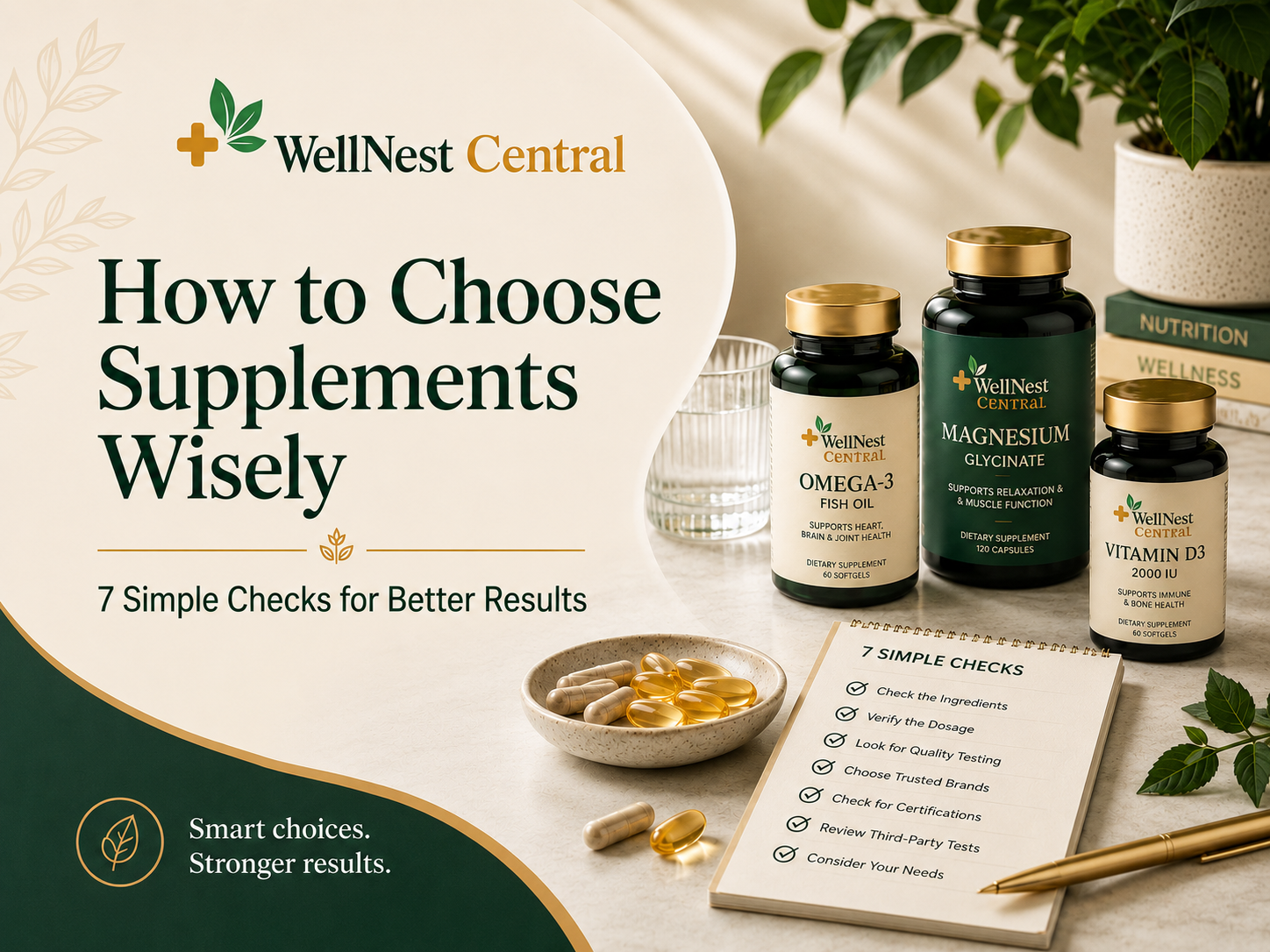
For many people, supplements are a practical way to support their nutritional routine.
They can provide vitamins, minerals, essential fatty acids and other nutrients in convenient forms, particularly when diet, lifestyle, age, food preferences, sunlight exposure or other circumstances make it difficult to obtain everything consistently from food alone.
The U.S. Food and Drug Administration notes that dietary supplements can help people maintain or improve overall health and can contribute toward meeting daily requirements for essential nutrients.
Similarly, the European Food Safety Authority describes food supplements as concentrated sources of nutrients or other substances that have nutritional or physiological effects.
The goal, therefore, does not need to be avoiding supplements.
A better question is:
How can you choose supplements more purposefully?
Once you understand a few basic principles, choosing supplements becomes much easier.
🌿 Need a practical place to start?
Visit The WellNest Supplement Guide to explore magnesium, omega-3, vitamin D, B vitamins, multivitamins and other supplement categories, together with regional shopping options.
The Guide is designed for an international audience, with shopping selections for Germany/EU, the United Kingdom, US/Canada, Australia/New Zealand and other countries worldwide.
Current partner stores include Body Attack and Life Extension UK, and the Guide can continue expanding as additional regional partnerships become available.
1. Start with what you want the supplement to support
The first step is surprisingly simple.
Ask yourself:
Why am I considering this supplement?
Perhaps you want to support your vitamin D intake during periods of limited sunlight.
Maybe you rarely eat oily fish and are interested in omega-3.
Perhaps you are considering magnesium as part of your daily nutrition routine.
Or maybe your eating pattern makes a B vitamin or multivitamin particularly useful.
Starting with a purpose makes supplement shopping much easier because you are no longer simply choosing whatever happens to be popular.
The NIH Office of Dietary Supplements defines supplements as products intended to supplement the diet and recognizes vitamins, minerals, botanicals, amino acids and other dietary ingredients within this category.
Think:
Need first. Product second.
That one principle can make your supplement routine much more focused.
2. Look beyond the front of the bottle
Supplement packaging can be attractive, but the most useful information is usually found on the label.
Look at:
- the main nutrient or active ingredient
- the amount provided per serving
- the recommended serving size
- the form of the nutrient
- additional ingredients in the formula
In the American system, dietary-supplement labels generally include a Supplement Facts panel showing serving size, dietary ingredients and the amount of each ingredient per serving.
This gives you a much better basis for comparing two products.
For example, two bottles may both say Magnesium on the front, but they may contain different forms of magnesium and different amounts per serving.
The front tells you what the product is called.
The label tells you what you are actually getting.
3. Consider the formulation
Supplements come in many forms.
You may find:
- capsules
- tablets
- powders
- liquids
- gummies
- softgels
The FDA recognizes these different forms as common ways dietary supplements are provided.
There is no need to assume that one format is automatically best for everyone.
Choose one that fits comfortably into your life.
Someone who travels frequently may prefer capsules.
Someone who dislikes swallowing tablets may prefer a liquid or powder.
Another person may find that taking one well-designed multivitamin is easier than remembering several different bottles every morning.
The formulation should help make your routine easier to maintain, not more complicated.
4. Choose an amount that makes sense for your purpose
Supplement labels often contain many numbers, which can make choosing products feel more complicated than it really is.
A simple approach is to ask:
How much of the nutrient does one serving provide?
Then consider how that amount fits with what you already receive from food and any other supplements you use.
The NIH Office of Dietary Supplements provides evidence-based fact sheets on individual vitamins, minerals and other supplement ingredients, including recommended amounts and other practical information.
Rather than choosing a product simply because it contains the largest number on the label, choose the amount that makes sense for your purpose.
This is particularly useful when comparing products such as:
Vitamin D — 1,000 IU vs 5,000 IU
or
Magnesium — 100 mg vs 300 mg
The larger number is not automatically the better product.
The better question is:
Which amount fits what I am trying to accomplish?
Personalised supplement guidance
Want Help Building a Safer, Simpler Supplement Routine?
The best choice depends on your goals, diet, medicines, health conditions and budget. WellNest Central can help you review what is genuinely useful and avoid an unnecessarily complicated routine.
5. Look for clarity and quality
A good supplement should make it relatively easy to understand what you are buying.
I like to use four simple questions:
What am I taking?
How much am I getting?
How am I supposed to take it?
Who makes it?
Clear labels make comparison much easier.
Both American and European systems have frameworks governing supplement products, although they regulate them somewhat differently.
In the United States, supplement companies are responsible for ensuring that products comply with applicable safety and labeling requirements, while the FDA oversees the dietary-supplement marketplace.
In the European system, food supplements are regulated as foods, and EU legislation governs permitted vitamins, minerals and their sources.
EFSA also evaluates scientific evidence behind health claims used for foods and supplements within the European market.
For you as the consumer, the practical lesson is straightforward:
Look for transparency rather than hype.
A straightforward product with a clear label can often tell you more than an extravagant marketing promise.
6. Keep your supplement routine manageable
You do not necessarily need ten different bottles.
A thoughtfully chosen routine might contain only a few supplements that have a clear purpose.
For example, depending on the individual, that could include:
Vitamin D
Magnesium
Omega-3
B vitamins
or a multivitamin
Someone else may have completely different priorities.
The important thing is that the routine fits your lifestyle well enough that you can actually maintain it.
A simple routine followed consistently is generally more practical than an elaborate schedule that becomes difficult to sustain.
Supplements also work best as part of the larger nutrition picture.
Food provides far more than isolated vitamins and minerals, so think of your supplements and your food choices as working together rather than competing with each other.
For additional ideas on incorporating nutrient-rich foods into your routine, you can also read Gut Health Juices: A Quick Guide on WellNest Central.
7. Personalize your supplements to your life
This is where supplementation becomes much more interesting.
Your needs are influenced by many things, including:
- your age
- eating pattern
- lifestyle
- activity level
- sunlight exposure
- health goals
- laboratory results where relevant
- life stage
That is why two healthy people do not necessarily need identical supplement routines.
Someone who regularly eats oily fish may approach omega-3 supplementation differently from someone who almost never eats fish.
Someone who eats animal products regularly may have different B12 considerations from someone following a vegan diet.
Someone living in a sunny climate may have a very different vitamin D situation from someone spending much of the year indoors.
This is why I prefer the idea of personalized supplementation rather than simply copying someone else’s supplement shelf.
American resources from the NIH Office of Dietary Supplements provide detailed information on individual nutrients, amounts and health considerations, while European organizations such as EFSA provide scientific assessments used in European nutrition and supplement guidance.
Where medication, pregnancy, significant health conditions or specialized high-dose supplementation are involved, a pharmacist or healthcare professional can also help you fit supplements intelligently into the rest of your health plan. The FDA and NIH both encourage discussing supplement use with healthcare professionals when individual circumstances need to be considered.
That does not need to make supplementation complicated.
It simply makes it personal.
A simple seven-step formula
If you find yourself looking at dozens of supplement bottles and wondering what to choose, remember:
Purpose → Nutrient → Form → Amount → Quality → Consistency → Personal fit
That is essentially the system.
You do not need to become an expert in nutritional biochemistry before purchasing a supplement.
You simply need to know what you are trying to achieve and how to evaluate the product in front of you.
That is the heart of learning how to choose supplements wisely.
Supplements, chosen with purpose
Supplements can be a useful and convenient part of a modern wellness routine.
They can help provide important nutrients, complement a varied diet and allow you to tailor your nutrition more closely to your circumstances. The FDA specifically recognizes that supplements can contribute to meeting essential nutrient requirements, while European authorities recognize supplements as concentrated sources of nutrients and other substances with nutritional or physiological effects.
The goal is not to own the greatest number of supplements.
The goal is to choose products with purpose.
Ask:
What am I trying to support?
Which nutrient makes sense?
Which formulation works for me?
Which product gives me a clear and practical way to obtain it?
Those questions can take much of the confusion out of supplement shopping.
🌿 Explore The WellNest Supplement Guide
Visit The WellNest Supplement Guide to explore practical supplement categories and region-based shopping options for:
Germany & the European Union · United Kingdom · United States & Canada · Australia & New Zealand · Other countries worldwide
The Guide currently includes partner shopping options through Body Attack and Life Extension UK, while its regional structure allows additional partners and markets to be incorporated as WellNest Central’s partnerships expand.
And if you would like to look at your nutrition, lifestyle and supplement routine more personally, you can Book Your One-on-One Consultation with WellNest Central for individualized holistic health guidance.



Pingback: Which Supplements Are Worth the Money? A Practical Value Guide
Pingback: Omega-3 After 40: Fish or Supplements?
Pingback: Vitamin B12 After 40: Signs, Tests and Supplements
Pingback: Parasite Cleanse: Does It Work? Risks and Testing
Pingback: Electrolyte Powder Every Day: Do You Really Need It?
Pingback: NAD+ Supplements: What NMN and NR Studies Show