For many years, health and fitness were often presented mainly in terms of becoming smaller.
Lose weight.
Reduce your waistline.
Fit into a smaller clothing size.
But the conversation is changing.
More people are beginning to recognise that health is not simply about how little you weigh.
It is also about how well your body works.
Can you climb stairs comfortably?
Can you carry your shopping?
Can you get up from a chair without difficulty?
Can you remain active and independent as you grow older?
This is where strength becomes important. If your goal also includes weight management, our guide to cardio vs strength training for weight loss explains how the two forms of exercise can work together.
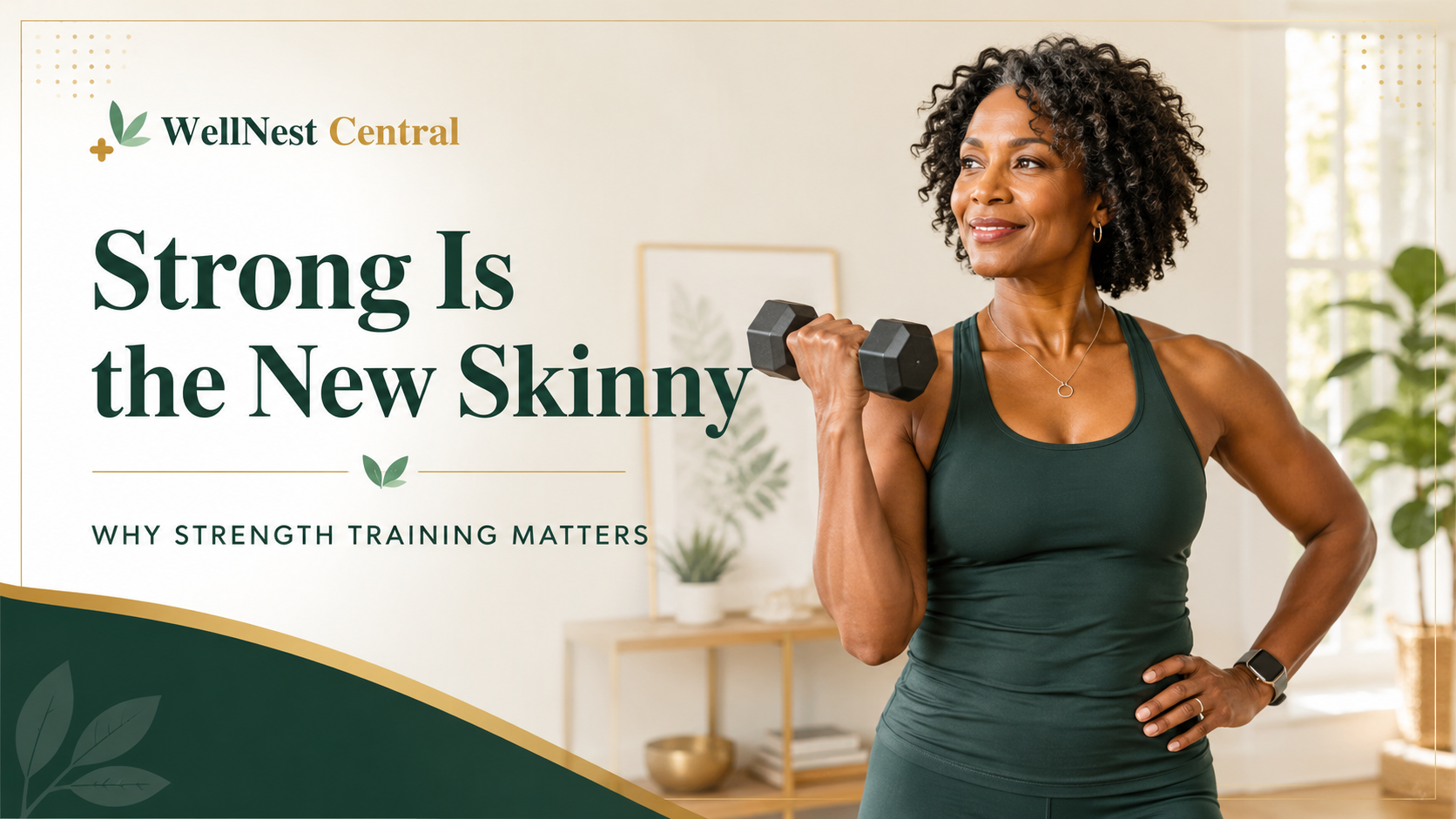
The phrase “Strong Is the New Skinny” reflects a more useful way of thinking about long-term health: instead of concentrating only on becoming smaller, we can also focus on becoming stronger, more capable and more resilient.
This shift is especially relevant as we age, because muscle mass and strength naturally tend to decline over time.
Strength training can help preserve both.
Harvard Health recently highlighted this shift in fitness thinking, particularly among women, noting that building muscle is increasingly replacing the old emphasis on simply staying slender.
PERSONALISED STRENGTH SUPPORT
Build strength with a plan that suits you
A one-on-one consultation can help you combine safe movement, nutrition, recovery and daily habits into a realistic approach shaped around your ability and goals.
Why Strength Matters More as You Age
Your muscles are involved in almost everything you do.
Standing.
Walking.
Lifting.
Balancing.
Climbing.
Carrying.
Getting out of bed.
Even maintaining good posture.
As we grow older, muscle mass and physical strength can gradually decrease.
This does not mean that weakness is inevitable.
Regular resistance or strength training can help preserve and improve muscle mass and strength as you age. Mayo Clinic also notes that strength training may help support bone health, weight management and overall physical function.
This is why strength training for healthy ageing deserves to be viewed as part of long-term health, not simply as something people do in a gym to change their appearance.
Strength Supports Everyday Independence
One of the most practical reasons to become stronger is simple:
Life becomes easier.
Think about ordinary activities such as:
- Carrying groceries
- Lifting a suitcase
- Climbing stairs
- Picking something up from the floor
- Carrying a child
- Moving furniture
- Gardening
- Getting in and out of a car
- Standing from a low chair
All of these require some combination of strength, balance and mobility.
You may never care about having large muscles.
But maintaining enough strength to perform everyday activities confidently can make a major difference to your quality of life.
Mayo Clinic Press notes that resistance training can help maintain physical function even into later decades of life, including among people who begin training at older ages.
Strong Muscles Can Support Stronger Bones
Strength training is not only about muscles.
Your bones also respond to physical loading.
When muscles pull against bones during resistance exercise, this provides a stimulus that can help support bone strength.
This becomes increasingly important as we age because bone density can gradually decline.
Mayo Clinic notes that resistance and weight-bearing exercise can support bone health and help reduce age-related bone loss.
That means exercises such as:
- Squats
- Lunges
- Resistance-band exercises
- Dumbbell exercises
- Body-weight movements
can contribute to both muscular and skeletal health when performed appropriately.
Strength Can Improve Balance and Mobility
Strength and balance are closely connected.
Strong legs and hips can help you stabilise your body when walking, turning, climbing stairs or recovering from a small loss of balance.
With ageing, reductions in muscle strength, flexibility and coordination can make falls more likely.
Regular physical activity that includes strength and balance work can therefore support mobility and stability.
This is another reason your fitness goals do not have to revolve only around weight loss.
A powerful goal could simply be:
I want to move confidently for as long as possible.
You Do Not Need to Become a Bodybuilder
One reason some people avoid strength training is that they imagine heavy weights, complicated gym equipment or bodybuilding routines.
That is not necessary.
Strength training simply means making your muscles work against resistance.
That resistance can come from:
- Your own body weight
- Resistance bands
- Dumbbells
- Kettlebells
- Gym machines
- Household objects
Mayo Clinic Press explains that resistance can come from body weight, bands, free weights, machines or even suitable household objects.
You can therefore begin at home without an expensive gym membership.
Five Simple Strength Exercises to Start With
1. Sit-to-Stands
Sit on a stable chair.
Stand up slowly.
Then sit back down with control.
This simple movement strengthens muscles used for standing, climbing and walking.
2. Wall Push-Ups
Stand facing a wall.
Place your hands against the wall and perform a controlled push-up.
This can be a gentle way to begin strengthening the upper body.
3. Squats
Squats strengthen the thighs, hips and gluteal muscles.
Beginners can start with shallow squats or use a chair for support.
4. Resistance-Band Rows
A resistance band can provide a practical way to strengthen the upper back, shoulders and arms.
5. Light Dumbbell Exercises
Simple movements such as curls, presses and rows can be performed using manageable weights.
Correct technique matters.
Mayo Clinic recommends learning proper weight-training technique and gradually progressing rather than trying to lift too much too soon.
How Often Should You Strength Train?
You do not need to exercise every day.
Mayo Clinic recommends working the major muscle groups at least twice per week as part of a balanced fitness routine, while allowing muscle groups adequate recovery between sessions.
A simple schedule might look like:
Monday: Strength training
Tuesday: Walking or light movement
Wednesday: Rest or mobility work
Thursday: Strength training
Friday: Walking
Weekend: Enjoyable physical activity
The best programme is not the most complicated one.
It is the one you can maintain.
Your Goal Does Not Have to Be “I Want to Weigh Less”
Weight can be one useful health measurement.
But it should not be the only measurement.
You might also ask:
Am I stronger than I was three months ago?
Can I climb stairs more easily?
Can I lift things with more confidence?
Am I moving better?
Do I feel more energetic?
Am I protecting my independence?
These are meaningful improvements.
Sometimes the scale changes slowly while your strength, mobility and body composition improve.
Progress is not always visible as a smaller number.
Strength Training and Weight Management
Strength training can also complement a healthy weight-management programme.
As muscle is maintained or built, body composition may improve even when body weight does not change dramatically.
Mayo Clinic notes that strength training can support weight management and improve body composition.
This is why combining strength exercise with:
- Balanced nutrition
- Adequate protein
- Good sleep
- Regular walking
- Stress management
- Sustainable eating habits
can be more useful than relying on aggressive calorie restriction alone.
Nutrition Matters Too
Exercise creates the stimulus.
Nutrition provides the materials your body needs to recover.
A balanced eating pattern should include:
Protein
Protein contributes to muscle maintenance and repair. For a balanced approach, see Proteinmaxxing: A Smarter, Balanced Approach to Eating More Protein.
Examples include:
- Eggs
- Fish
- Poultry
- Yogurt
- Quark
- Beans
- Lentils
- Tofu
- Nuts
- Seeds
Vegetables and Fruit
These provide vitamins, minerals, fibre and plant compounds.
Fibre-Rich Carbohydrates
Foods such as oats, whole grains, potatoes, rice, beans and lentils can support energy and overall nutrition.
Healthy Fats
Foods such as olive oil, avocado, nuts and seeds can contribute beneficial fats.
Fluids
Hydration remains important for physical performance and recovery.
Recovery Is Part of Strength
Muscles do not only improve during exercise.
They also need recovery.
Useful recovery habits include:
- Adequate sleep
- Rest days
- Good hydration
- Balanced meals
- Gradual progression
- Managing stress
More exercise is not always better.
A sustainable rhythm of training and recovery is usually more useful than repeatedly exhausting yourself.
Start Where You Are
You do not need to wait until:
You lose weight.
You join a gym.
You buy expensive equipment.
You feel completely motivated.
Start where you are.
If five controlled sit-to-stands are challenging today, begin there.
If you can walk for ten minutes, begin there.
If you can use a light resistance band, begin there.
Then gradually progress.
Small improvements repeated consistently can become significant over time.
Consistency Beats Perfection
One of the biggest mistakes people make with exercise is trying to change everything at once.
They begin with an extreme routine.
Exercise every day.
Follow a strict diet.
Cut out multiple foods.
Train too hard.
Then become exhausted and stop.
A more sustainable approach is:
Start small.
Build gradually.
Stay consistent.
The objective is not to have one perfect week.
It is to create habits you can maintain for years.
Strength Is About Your Future
Think beyond what your body looks like today.
Imagine yourself:
At 50.
At 60.
At 70.
At 80.
What would you like your body to allow you to do?
Travel?
Walk independently?
Play with grandchildren?
Carry your own shopping?
Climb stairs?
Garden?
Exercise?
Live without constantly needing help?
Strength training can become an investment in those future abilities.
Frequently Asked Questions
Is strength training safe for beginners?
Yes, when exercises are appropriate for your ability and performed with correct technique.
Begin conservatively and progress gradually.
Am I too old to start strength training?
No.
Evidence indicates that older adults can still respond positively to resistance training, including people who begin later in life.
Do I need a gym?
No.
Body-weight exercises, resistance bands and simple weights can all be used at home.
Will strength training make me bulky?
Most recreational strength programmes are designed to improve strength and function rather than create a bodybuilding physique.
Is walking enough?
Walking is excellent for cardiovascular health and general movement, but it does not fully replace resistance training for maintaining muscular strength.
A well-rounded routine can include both. Short bouts of movement can also help you stay active between planned sessions; read Exercise Snacks: How Short Bursts of Movement Support Health.
Final Thought
The idea behind strength training for healthy ageing is simple:
Your body is not only something to make smaller.
It is something to nourish.
Something to move.
Something to strengthen.
And something worth protecting for the future.
Strong is not simply the new skinny.
Strong is one of the foundations of living well.
READY TO FEEL STRONGER?
Support your mobility, energy and future independence
Book a private consultation for practical guidance on strength, nutrition, recovery and sustainable routines that respect your current fitness and health.
Anthony Ofori | Medical Graduate in General Medicine | Founder, WellNest Central
Last reviewed: 13 September 2026
This article provides general health education and does not replace individual medical assessment, diagnosis or treatment. If you have pain, balance concerns, cardiovascular disease, osteoporosis or another health condition, seek advice from an appropriately licensed healthcare professional before beginning a new exercise programme.